Tax benefits today. Long-term investment growth for tomorrow. Here’s how a Retirement Annuity works and where it could fit into your retirement plan.
A Retirement Annuity (RA) is a tax-efficient investment designed specifically to help South Africans build wealth for retirement. It can be particularly useful if you’re self-employed, don’t belong to an employer retirement fund, or simply want to supplement your existing retirement savings.
THE RA RULES TO KNOW
There are a few important benefits and rules:
- Qualifying retirement-fund contributions may be tax-deductible up to 27.5% of the greater of remuneration or taxable income, subject to an annual limit of R430,000 for the 2026/27 tax year.
- If your qualifying contributions exceed the annual deduction limit, the excess can generally be carried forward to future tax years.
- Investment growth within the RA is not subject to income tax, capital gains tax or dividend withholding tax while invested.
- Since 1 September 2024, retirement funds have a Vested, Savings and Retirement Component. The Savings Component provides limited access to a portion of your retirement savings before retirement, subject to the applicable rules and tax.
- An RA is designed for long-term retirement savings. You cannot simply withdraw the full investment whenever you want.
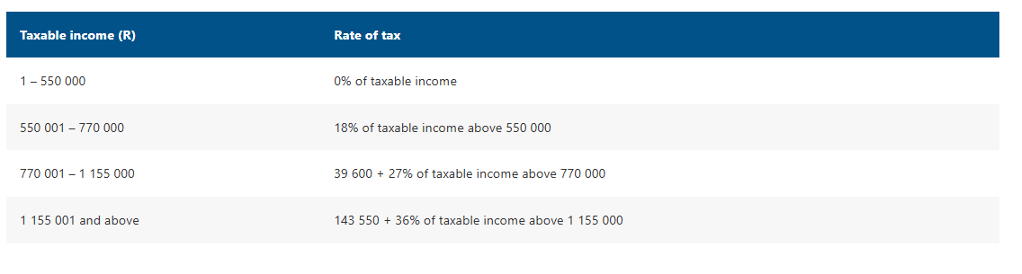
- At retirement, you can take up to one-third as a lump sum (R550 000 is free of tax; see SARS Retirement Tax Table) with the balance used to provide a retirement income (Living Annuity), subject to the applicable rules and thresholds.
- RAs are subject to Regulation 28, which governs how retirement funds may invest
- The proceeds of an RA on death are generally dealt with by the fund’s trustees in terms of Section 37C of the Pension Funds Act, rather than simply being distributed according to your Will.
- Retirement age is 55.
HOW DOES THE TAX DEDUCTION WORK?
One of the key benefits of contributing to a Retirement Annuity is that qualifying contributions can reduce your taxable income (this also includes employee and employer pension/provident fund contributions), which can reduce the amount of tax you pay. You can deduct up to 27.5% of the greater of your remuneration or taxable income, subject to the annual R430,000 limit for the 2026/27 tax year.
Example 1 – 27.5% limit:
If you earn R1,000,000 a year, 27.5% of your income is R275,000. This means you could contribute up to R275,000 to your retirement funds and claim the full amount as a tax deduction, subject to your individual circumstances.
Example 2 – R430,000 cap:
If you earn R2,000,000 a year, 27.5% is R550,000. However, because the annual deduction is capped at R430,000, the maximum deductible contribution for that tax year would be R430,000.
Any qualifying contributions above the annual deduction limit are not lost and can generally be carried forward for use in future years.
WHAT HAPPENS TO MY MONEY INSIDE AN RA?
One of the key benefits of an RA is that your investment can grow without income tax, dividends tax or capital gains tax being charged on the investment returns while it remains in the fund. Over the long term, this means more of your money stays invested and can continue to grow through compounding.
RAs are also subject to Regulation 28, which sets limits on how retirement funds can invest. This helps ensure that your retirement savings are properly diversified and not overly concentrated in any one type of investment.
HOW DOES THE TWO-POT SYSTEM WORK?
Since 1 September 2024, new retirement-fund contributions are generally split between two components:
- Savings Component: One-third of new contributions goes into this component. You can make one withdrawal per tax year, with a minimum withdrawal of R2,000. Withdrawals are taxed at your marginal tax rate.
- Retirement Component: Two-thirds of new contributions goes into this component and must remain invested until retirement.
You may also have a Vested Component, which consists of retirement savings built up before 1 September 2024 and is subject to the rules that applied before the two-pot system.
The two-pot system provides some flexibility to access a portion of your retirement savings when needed. However, withdrawing money early reduces the amount you have available to grow towards retirement, and is taxed heavily at your marginal tax rate (income tax).
WHAT HAPPENS TO MY INVESTMENT UPON MY DEATH?
In terms of Section 37C of the Pension Funds Act, the proceeds of a Retirement Annuity Fund upon death do not automatically form part of the deceased’s estate. Instead, the fund’s trustees are responsible for identifying the deceased’s dependants, using beneficiary nominations as a guide, and determining how the death benefit should be allocated and distributed, in accordance with the requirements of the Act.
WHEN CAN I ACCESS MY RA?
From age 55, or earlier only for permanent ill-health/disability, formal emigration (after 3 uninterrupted years as a tax non-resident), or if the RA value is less than R15 000.00.
What happens when I retire?
You can withdraw a maximum of one-third of your total RA value in cash (the first R550 000 is tax-free, aggregated across all retirement products); the remaining two-thirds is used to purchase an annuity (retirement income). If the value of the RA is less than R360 000.00, you may elect to withdraw the full value.
RA OR TFSA?
It doesn’t necessarily need to be one or the other. An RA may provide an upfront tax deduction, but your money is primarily intended for retirement and is subject to retirement-fund rules.
A TFSA doesn’t provide an upfront tax deduction, but qualifying investment returns and withdrawals are tax-free, and you have greater access to your capital. For many investors, the two can complement each other as part of a broader long-term investment strategy.
For more information on TFSA, click here
BUILD A RETIREMENT PLAN, NOT JUST A RETIREMENT PRODUCT
An RA can be a powerful way to build long-term retirement wealth, but simply having one doesn’t mean you’re on track. How much should you contribute? How should your money be invested? Are you taking the right level of risk? And how should your RA work alongside your TFSA and other investments?
At Harbour Wealth, we look at your retirement savings as part of your complete financial picture, helping you build a strategy around your goals, time horizon and financial circumstances.
Understanding your Retirement Annuity
Retirement Annuities are powerful investment tools, but they are also complex, with a number of rules, tax considerations and restrictions that can affect how and when you access your money. It’s important to understand how your RA works, keep yourself informed, and regularly review factors such as your investment strategy, fees, contributions and retirement goals.
This is where Harbour Wealth can help. We believe that good financial planning starts with understanding your options, and our advisers are here to help you navigate the rules, assess whether an RA is right for you, and ensure that it forms part of a broader retirement strategy suited to your individual circumstances. If you’re unsure about your RA or simply want to make sure you’re making the most of it, speak to a Harbour Wealth adviser – we’re here to help.
Retirement fund lump-sum benefits or severance benefit tax table:
FAQ: RETIREMENT ANNUITIES IN SOUTH AFRICA
1.1.1 What is a Retirement Annuity?
A Retirement Annuity is a South African retirement fund that allows individuals to invest towards retirement independently of an employer-sponsored pension or provident fund.
1.1.2 Are Retirement Annuity contributions tax-deductible?
Qualifying retirement-fund contributions can be deducted subject to the limits in section 11F of the Income Tax Act. For 2026/27, the annual deduction cap is R430 000, alongside the applicable 27.5% and taxable-income limits.
1.1.3 Can I withdraw money from my RA before retirement?
The two-pot retirement system allows eligible members to access money in their savings component subject to specific rules. Generally, one savings-component withdrawal is permitted per tax year, with a minimum withdrawal of R2 000.
1.1.4 Is an RA tax-free?
Investment returns within the retirement fund aren’t taxed while invested. However, withdrawals and retirement benefits can be subject to tax depending on the nature of the payment and applicable tax rules.
1.1.5 Is an RA better than a TFSA?
Neither is inherently better. They provide different tax benefits and access rules and can often complement each other within a broader financial plan.
1.1.6 What happens to my RA when I retire?
Your options depend on the components within your retirement fund and the applicable retirement rules. Retirement-component savings are generally used to provide retirement income, while different rules can apply to savings and vested components.