Your investments may be growing in rands, but are they keeping pace with the cost of the life you want to live?
Building wealth takes time, discipline, and careful planning. Watching your investments grow is reassuring, particularly when you’ve spent years working towards financial independence.
However, the value of your wealth isn’t only determined by the balance on your investment statement. What matters just as much is what that money will allow you to do in the future.
For many South Africans, those plans extend beyond our borders. It might be an overseas holiday, visiting children who have emigrated, helping to fund an international education or enjoying the freedom to travel during retirement.
These are all experiences that can become more expensive when the rand weakens, even when your investments are performing well.
Understanding how your wealth measures up against other currencies is therefore an important part of long-term financial planning.
Is Your Wealth Really Growing?
Consider a simple example.
You have R900,000 invested, and over the course of a year, your portfolio delivers a 10% return. Your investment is now worth R990,000, which represents a healthy increase in rand terms.
During that same period, however, the exchange rate moves from R18 to R20 against the US dollar.
At the beginning of the year, your R900,000 was worth $50,000. Despite the investment growing to R990,000, its dollar value is now $49,500.
Your investment has grown by 10% in rands, yet its value in dollars has declined by 1%.
This doesn’t mean the investment has performed poorly. It simply illustrates how currency movements can affect the purchasing power of your wealth, particularly when you intend to spend some of it internationally.
A South African family planning a holiday in Europe, for example, faces the same hotel prices as a family earning in dollars or euros. The difference lies in how much of their income or savings they need to exchange to afford that holiday.
Looking at your investment returns in more than one currency can provide a clearer picture of whether your wealth is keeping pace with your future plans.
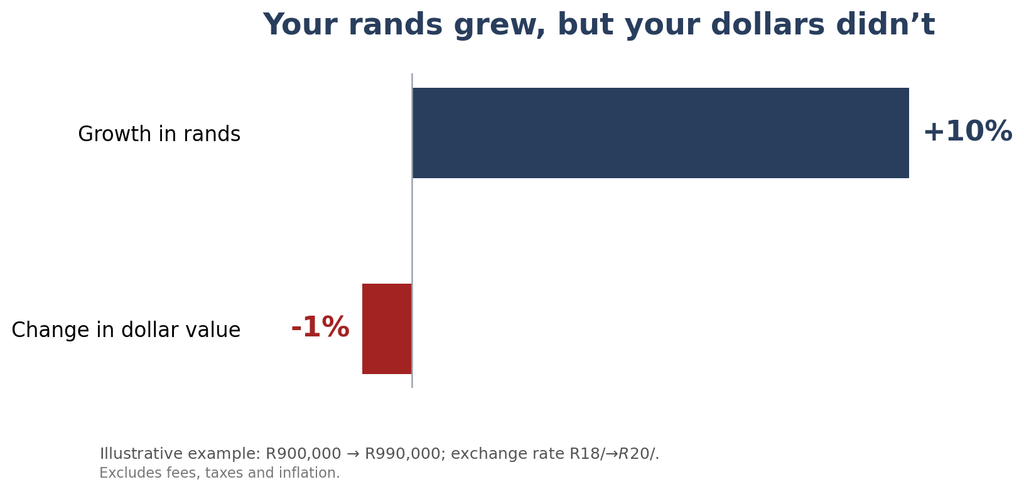
This graph shows a comparison showing the investment’s 10% growth in rands against its 1% decline in dollar value.
Global Prices Affect Us Here at Home Too
Currency movements aren’t only relevant to people who travel or invest internationally. They also influence many of the expenses we face in South Africa.
Fuel is one of the clearest examples. Oil is priced internationally in US dollars, which means a weaker rand can increase the cost of importing fuel, even when the international oil price remains unchanged.
Higher fuel prices can affect transport, food distribution and the cost of delivering goods, creating additional pressure on household budgets.
The same applies to many imported products, including electronics, vehicles and certain household goods. While exchange rates are not the only factor determining these prices, they can have a meaningful impact on what South Africans pay.
This connection to global markets is worth considering when planning for the future. Even if you expect to spend most of your retirement in South Africa, changes in international prices and exchange rates may still influence your cost of living.
Your financial plan should take these realities into account, particularly when considering how to preserve your purchasing power over the long term.
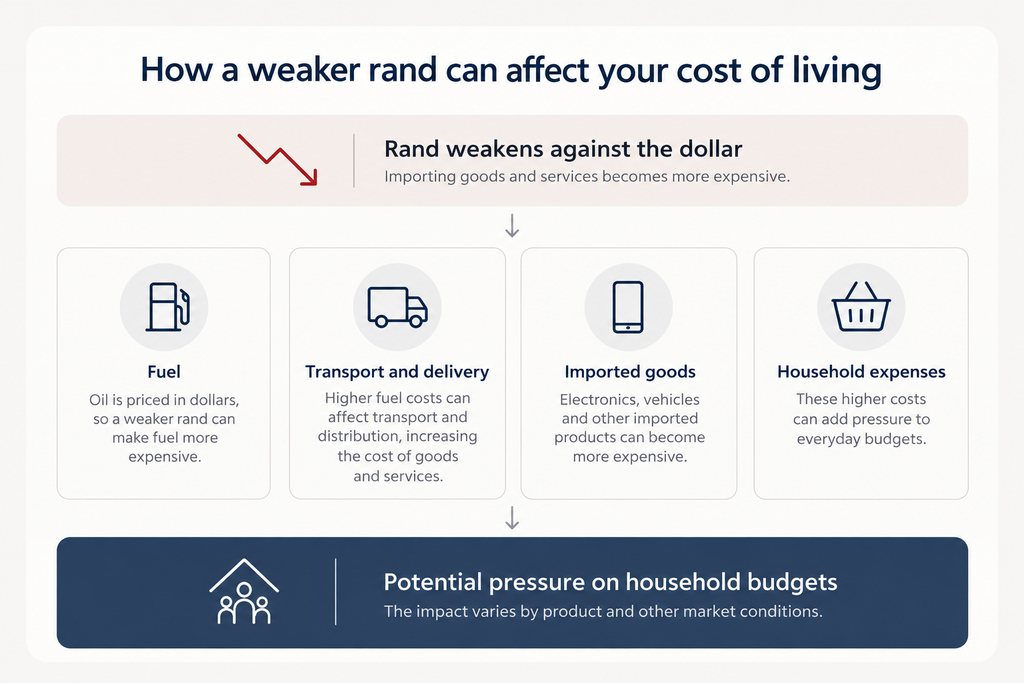
How a weaker rand can influence fuel, transport, imported goods and household expenses.
Why Offshore Investing Deserves a Place in the Conversation
Offshore investing is often associated with protecting wealth against a weakening rand. While currency diversification is an important consideration, the benefits of international investing extend further.
Investing globally provides access to economies, industries and businesses that may not be well represented in the South African market. It also allows investors to spread their exposure across different currencies and economic environments.
For someone planning to spend part of their retirement overseas, support family living abroad or fund future international expenses, having investments denominated in foreign currency can also help align their assets with those financial commitments.
The objective isn’t necessarily to move as much money offshore as possible. It’s to determine what level of international exposure makes sense within your overall investment strategy.
There is also an important difference between holding foreign currency and investing for long-term growth.
Money held in dollars, for example, remains exposed to inflation. If the cost of living in the United States increases, the purchasing power of those dollars can decline, even if the amount in your account stays the same.
For this reason, offshore investment decisions should consider the potential for investment growth, inflation, costs, taxes and the time available to achieve your goals.
International investments carry their own risks. Global markets experience periods of volatility, and a strengthening rand can reduce the rand value of offshore assets.
A well-considered investment strategy recognises these risks and aims to create an appropriate balance between local and international opportunities.
Understanding Your Offshore Investment Options
There are different ways to gain exposure to international markets, and understanding how your money is invested and where it is held can help you make more informed decisions.
Investing through a locally held offshore fund
One option is to invest in a rand-denominated feeder fund that provides access to international investments.
Your investment is made through a South African platform, while the underlying assets are invested offshore. This allows you to benefit from exposure to global markets and currency movements without necessarily transferring your capital out of the country.
For many investors, this can be a practical way to introduce international diversification into an existing portfolio.
Investing directly offshore
Direct offshore investing involves transferring funds abroad and investing through an appropriate foreign-currency account or investment structure.
Depending on the arrangement, your investments and their proceeds can remain offshore, which may be particularly useful if you expect to have financial commitments in another country.
For example, someone whose children live overseas may want access to foreign-currency funds for regular visits or future family expenses. Others may be considering international property, education costs or spending part of their retirement abroad.
Both approaches offer international investment exposure, but they differ in how the assets are held, how funds can be accessed and the associated administrative, tax and estate-planning considerations.
The most suitable approach will depend on your individual circumstances, financial objectives and longer-term plans.
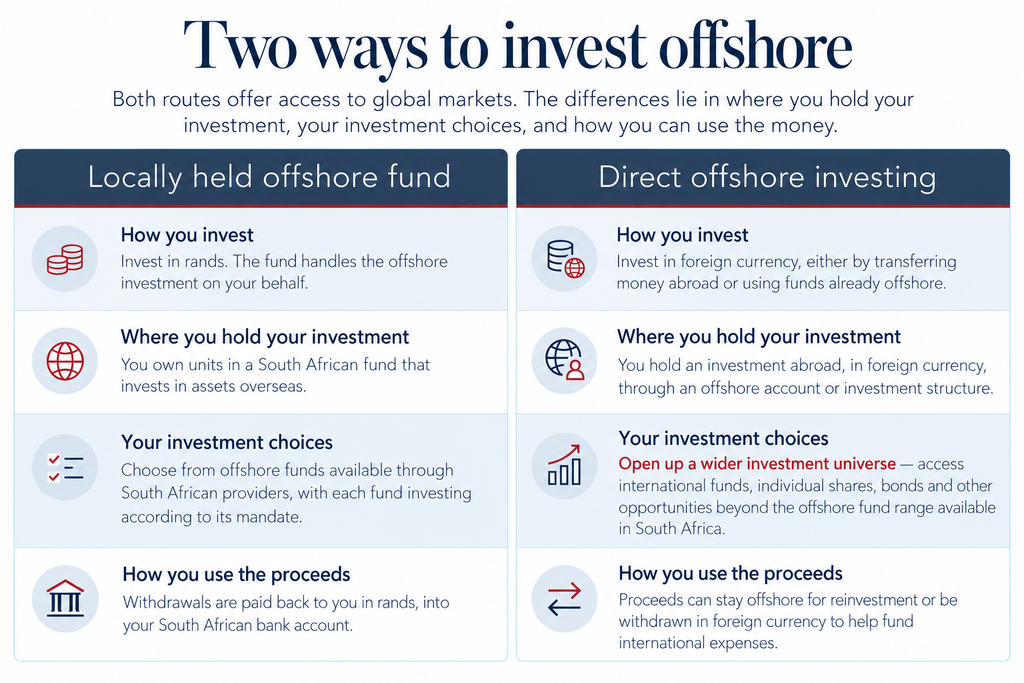
A simple side-by-side comparison of locally held offshore funds and direct offshore investments.
Planning for the Life You Want to Live
Financial planning is ultimately about more than investment performance. It’s about ensuring that the wealth you’ve built can continue to support your lifestyle, your family and the opportunities that matter to you.
For some people, this means having the financial freedom to travel regularly. For others, it may involve supporting children who live abroad, providing for an international education or simply maintaining their standard of living as economic conditions change.
These goals may require different investment strategies, particularly when future expenses are likely to be incurred in currencies other than the rand.
The starting point is to understand your existing international exposure, consider where your future expenses may arise and assess whether your current investment strategy is appropriately positioned.
At Harbour Wealth, we take a holistic approach to financial planning, considering your local financial needs alongside your longer-term goals and international investment opportunities.
Your Harbour Wealth adviser can help you review your existing portfolio, understand the different ways to invest offshore and determine how global exposure may fit into your broader wealth strategy.
You’ve worked hard to build your wealth. Making sure it continues to support the life you’ve planned is just as important.
Speak to your Harbour Wealth adviser about reviewing your global investment exposure and ensuring your investment strategy remains aligned with your future goals.