The US midterm elections 2026 have dramatically changed the political landscape in Washington. Democrats have won control of Congress, but Donald Trump remains president. So, what does this actually mean for his presidency, and why should the rest of the world, particularly South African investors, be paying attention?
Donald Trump hasn’t lost the presidency. But he has lost something that could make his remaining two years in the White House considerably more complicated.
On 3 November 2026, American voters delivered a significant political shift. The Democratic Party won control of both chambers of Congress, ending Republican control of the country’s legislature.
Trump will remain president until January 2029, but from January 2027, he will have to govern alongside a Congress controlled by his political opponents.
For South Africans, this might seem a little strange. In our political system, the president is elected by the National Assembly and depends on its continued support. In America, things work differently.
So, what exactly did the Democrats win? How much power does Trump still have? And why could an election that didn’t even involve choosing a president have such significant consequences?
What Are the US Midterm Elections 2026?
To understand what happened, it helps to understand one of the biggest differences between the American and South African political systems.
In South Africa, the National Assembly elects the president. In the United States, Americans elect their president separately from Congress, the institution responsible for making federal laws.
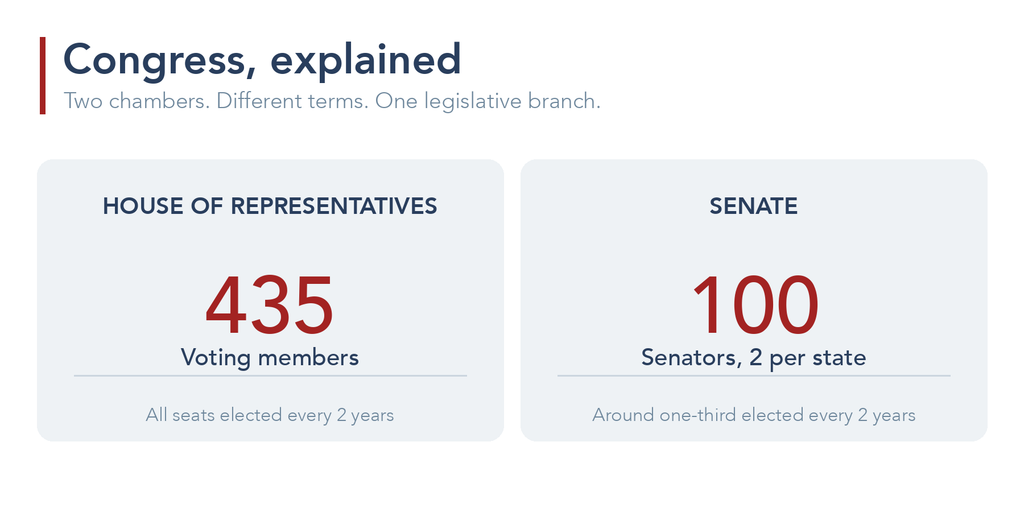
Congress consists of two chambers:
- The House of Representatives: Made up of 435 voting members, each representing a particular geographical district. All 435 seats are contested every two years.
- The Senate: Consists of 100 senators, two from each of America’s 50 states. Senators serve six-year terms, with approximately one-third facing election every two years.
Together, these chambers debate and pass legislation, approve government spending, oversee the executive branch and, through the Senate, approve certain presidential appointments.
While American presidents serve four-year terms, Congressional elections take place every two years. Those held halfway through a president’s term are known as the midterm elections.
Essentially, Americans get an opportunity to change the balance of political power in Washington without having to elect a new president.
And that’s exactly what happened in November.
So, What Have the Democrats Actually Won?
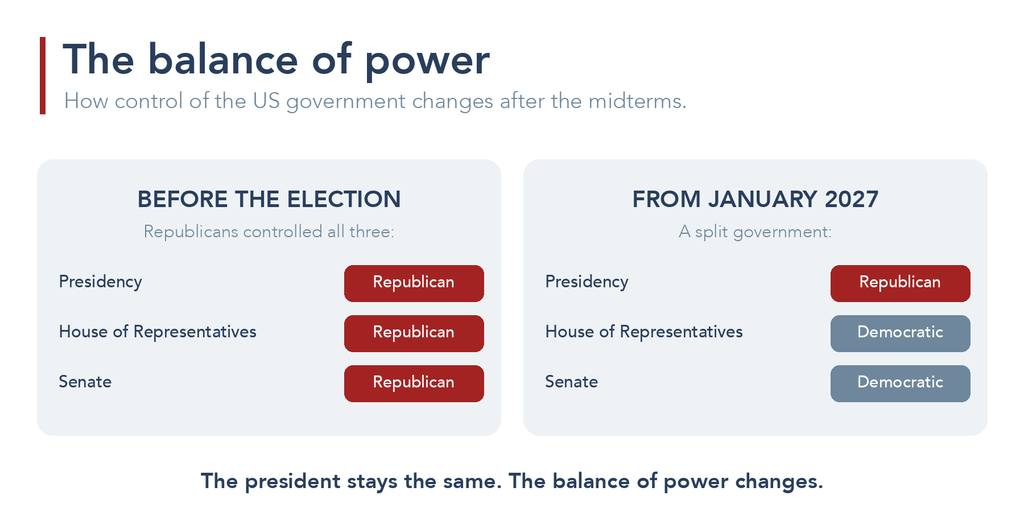
Before the election, Republicans controlled the presidency, the House and the Senate. This gave Trump the advantage of working with lawmakers from his own party when trying to advance his political agenda.
From January, that advantage disappears.
With Democrats controlling both chambers, they will have considerably more influence over which legislation advances, how government spending is negotiated and how the administration is held accountable.
They can also investigate government decisions, call officials to testify before Congressional committees and challenge presidential appointments.
But here’s where American politics becomes interesting.
Winning Congress doesn’t mean the Democrats can simply do whatever they want. And losing Congress doesn’t mean Trump becomes powerless.
The American Constitution deliberately divides authority between the president, Congress and the courts. This system of checks and balances is designed to prevent any one institution from exercising unchecked power.
When different parties control these institutions, the result can be political confrontation, but sometimes also compromise.
How Much Power Does Trump Still Have?
Imagine Democrats pass a new law that Trump strongly opposes.
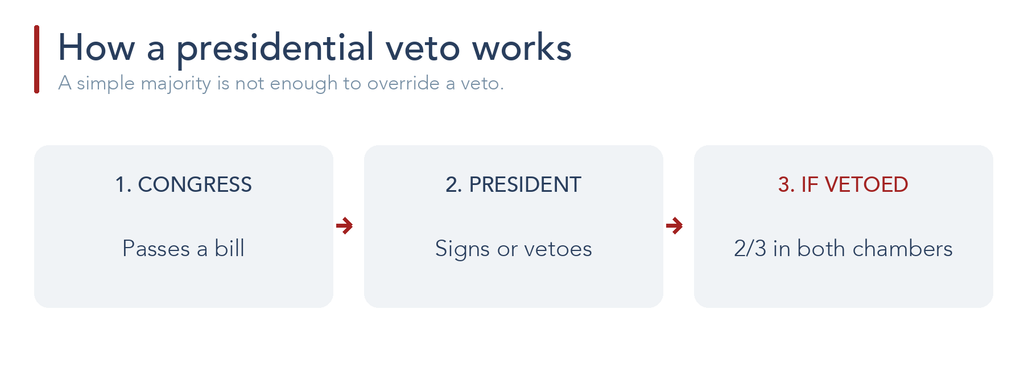
He can simply refuse to sign it. This is known as a presidential veto.
Congress can overturn that veto, but doing so requires a two-thirds majority in both chambers, considerably more than the simple majority needed to pass most legislation.
In other words, Democrats may control Congress, but that doesn’t automatically give them the numbers needed to force legislation past the president.
The same principle works in reverse.
If Trump wants to introduce a major new law, he will need Congressional support. Democrats can block his proposals or demand concessions before agreeing to them.
Trump also retains substantial authority as president. He can continue directing the federal administration, conducting foreign policy, issuing executive orders within his legal authority and commanding the armed forces.
Executive orders, however, cannot simply replace laws passed by Congress and may be challenged in the courts.
Democrats will also gain greater power to investigate Trump’s administration and could initiate impeachment proceedings. But impeachment alone does not remove a president. Conviction and removal require a two-thirds majority in the Senate.
The distinction is important: Trump hasn’t lost his presidential powers. He’s lost the political support in Congress that made exercising some of them considerably easier.
History Shows This Can Get Complicated
Trump is certainly not the first American president to find himself in this position.
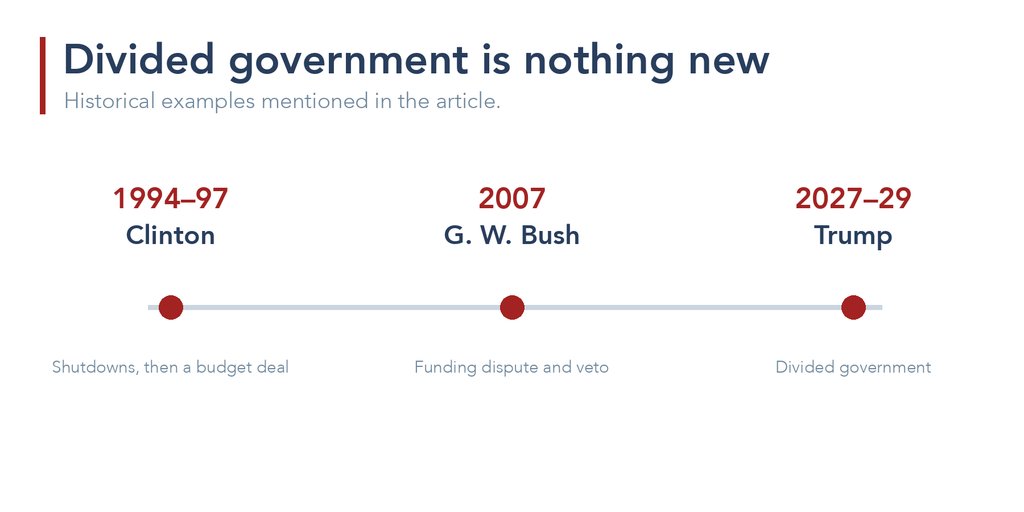
In 1994, Democratic President Bill Clinton suffered a major midterm defeat when Republicans took control of both chambers of Congress.
What followed was a bitter disagreement over government spending, eventually resulting in two federal government shutdowns during 1995 and 1996.
For weeks, parts of the American government were unable to operate normally because the president and Congress couldn’t agree on how government expenditure should be funded.
Yet the same political opponents eventually found common ground. In 1997, Clinton and Republican Congressional leaders negotiated a bipartisan budget agreement, demonstrating that divided government doesn’t always mean political paralysis.
A second example came in 2007, during Republican President George W. Bush’s administration.
Democrats had taken control of Congress while the United States was deeply involved in the Iraq War. They attempted to use their influence over military funding to introduce a timetable for withdrawing American troops.
Bush disagreed and vetoed the legislation.
Unable to secure enough votes to override his decision, Congress eventually passed a revised funding package without the withdrawal timetable.
These two examples illustrate the central tension of divided government. Congress can make a president’s life considerably more difficult, but the president can still resist its demands.
What Could This Mean for the Conflict in Iran?
The ongoing conflict involving the United States and Iran provides a particularly relevant example of how these powers could come into conflict.
Although diplomatic efforts are underway, the conflict remains unresolved, with the US maintaining a naval blockade and the administration retaining the option of further military action.
As commander-in-chief, Trump retains authority over the American armed forces. However, Congress controls federal spending and has important constitutional powers relating to war.
This means Democrats could investigate military decisions, challenge the administration’s strategy or attempt to place conditions on future military funding.
But, as Bush demonstrated in 2007, imposing those conditions is not necessarily straightforward. Legislation restricting military operations may face a presidential veto, and Congress would need sufficient support to overcome it.
The result could be difficult negotiations between the White House and Congress over America’s military involvement.
It is also important to recognise that Congressional opposition does not automatically end a military operation. The relationship between presidential military authority and Congress’s powers over war and funding is more complicated than that.
The real significance of the midterms is that Trump’s military and foreign-policy decisions will now face scrutiny from a Congress controlled by the opposition.
Why Should South Africans Care?
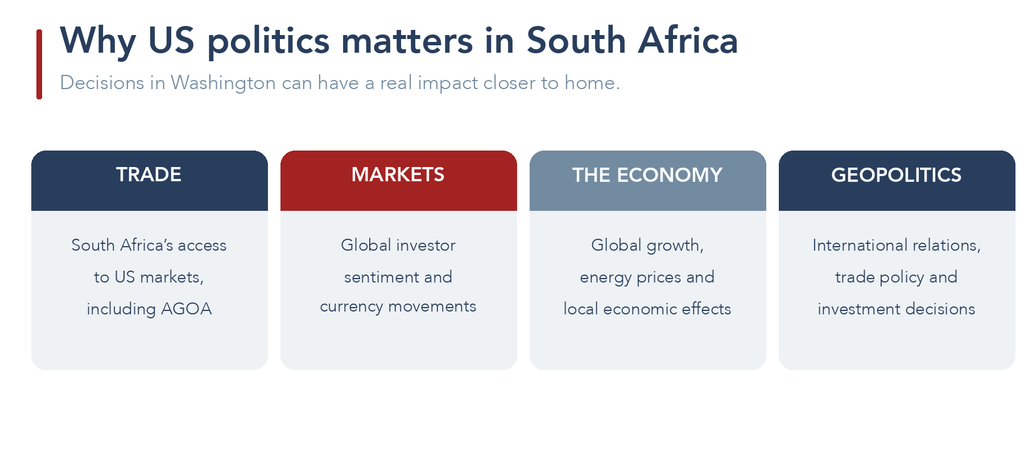
American political developments rarely remain confined to American borders.
Decisions made in Washington influence international trade, global investment markets, commodity prices, exchange rates and geopolitical stability.
South Africa has already experienced the consequences of strained relations with the United States.
On 2 November, the Trump administration announced its intention to withdraw South Africa’s preferential trade benefits under the African Growth and Opportunity Act (AGOA), effective 1 January 2027.
The Democratic victory does not automatically reverse that decision. However, a change in Congressional control could influence future scrutiny, negotiations and the broader direction of American trade policy.
For South African investors, developments in Washington can also affect global market sentiment, energy prices and the rand. For a closer look at what’s happening across global and local investment markets, explore our latest market performance insights.
Political developments can create uncertainty in financial markets, which is why understanding how to navigate market volatility is an important part of long-term investing.
Understanding how American political decisions are made therefore provides useful context when considering events that may ultimately affect our own economy.
A Different Presidency for the Next Two Years
The midterms haven’t ended Trump’s presidency, but they have changed the political environment in which he must govern.
History suggests that divided government can lead to difficult funding negotiations, investigations and disputes over policy. It also shows that cooperation remains possible when both political parties see value in reaching an agreement.
For Trump, the challenge will be advancing his remaining agenda while navigating a Congress controlled by his political opponents.
For Democrats, the challenge will be translating their electoral victory into meaningful Congressional influence, while recognising the constitutional powers the president still holds.
While political developments can influence markets in the short term, investors should be careful not to let every headline dictate their financial decisions. As we’ve explored before, consistency is one of the smartest long-term investment strategies.
And for the rest of the world, the next two years will offer an important reminder of how American democracy works: even the president of the United States cannot govern entirely on his own.